 英语
 中文简体
 西班牙语
Product Consultation
Your email address will not be published. Required fields are marked *
DTF vs Sublimation Printer: Which System Fits Your Fabric Mix and Workflow?
Nov 06,2026
Jumbo roll supply of food packaging paper|Hydrotech invites you to meet at the INTERPACK CHINA 2026
Nov 06,2026
Canton Fair ends|Three major paper products were unveiled, Hydrotech looks forward to seeing you again
Nov 04,2026
Content
Put two identical 100 percent cotton hoodies on the same table, run the same twelve-colour chest graphic on both, and you get two very different garments. One feels like the fabric was never touched. The other carries a thin, slightly raised layer you can catch with a fingernail. That is DTF versus DTG in your hands, and it comes from one structural fact: DTG puts ink into the shirt, DTF puts a film on top of it.
Everything else that matters on a production floor follows from that fact. Fabric range, pretreatment time, wash life, cost per piece, and how badly a bad print hurts your day all trace back to whether the ink touches the garment directly or rides on an adhesive layer.
DTG, or direct-to-garment, prints water-based pigment ink straight onto a pretreated garment. DTF, or direct-to-film, prints the design onto a transfer film, coats it with hot-melt adhesive powder, and heat-presses the finished transfer onto the fabric.
A DTG line runs in three stages: pretreat, print, cure. The pretreat liquid is applied by roller or spray and dried before printing, then the head lays down a white ink pass and CMYK on top. Curing happens in a heat press or tunnel, typically around 160 C for 60 to 90 seconds depending on the ink set. Because the pigment sits inside the cotton fibres, the print keeps the texture and drape of the shirt.
A DTF line runs in four stages: print, powder, cure, press. The printer lays a mirror-image design with a white underbase onto a PET or paper-based film. Hot-melt adhesive powder is applied while the ink is still wet, shaken off, and the film is cured. The operator then presses at roughly 150 to 165 C for 10 to 15 seconds and peels. The adhesive layer, not the ink, is what bonds the graphic to the fabric.
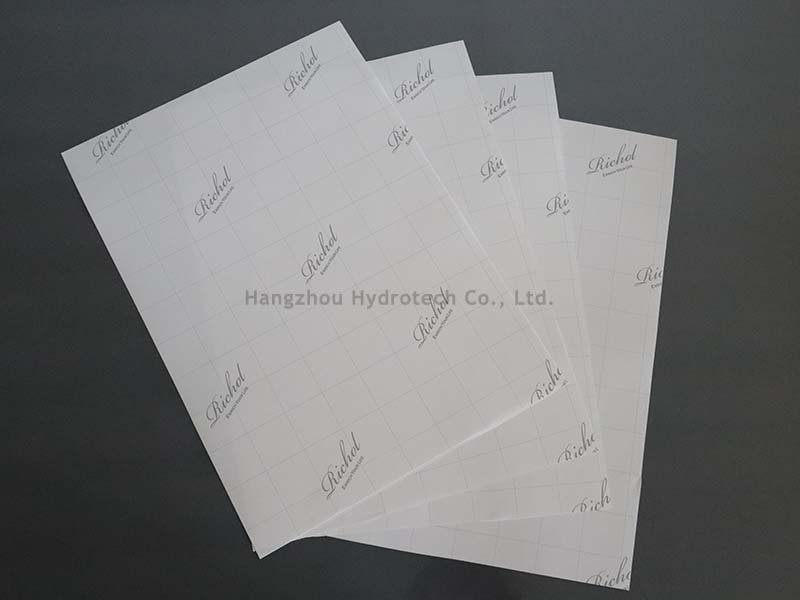
The film base matters more than most buyers expect. PET film gives the sharpest detail and the flattest finish. Paper-based heat transfer film is the lower-waste option: it handles the same cotton and blend work, takes powder cleanly, and avoids the plastic carrier that ends up in the bin after every job. For shops printing daily, that consumable choice quietly sets both the material cost and the waste volume.
 Paper-Based DTF Heat Transfer Film DTF 3.0-HPRecyclable paper-based DTF film with plastic-free coating, hot/cold peel, and HP-1308/HP-1310 options for cotton, polyester, nylon, and treated leather.View Product →
On cotton-rich garments DTG usually wins on hand feel, while on everything else DTF is more forgiving. The table below covers the variables that decide most real orders.
| Variable | DTG | DTF |
| Fabric range | 100 percent cotton and cotton-rich blends | Cotton, polyester, blends, nylon, canvas, leather |
| Pretreatment | Required, especially on dark garments | Not required |
| Hand feel | Soft, sinks into the fibre | Thin film on top, slightly raised on large areas |
| White on dark shirts | Heavy white pass plus pretreat | White layer built into the film |
| Gradients and photos | Smooth tonal transitions | Crisp and saturated, with fine halftone grain |
| Typical wash life | 25 to 40 washes on cotton | 50 washes and above on tested films |
| Setup per job | Pretreat, print, cure | Print film, powder, press |
| Runs that suit it | 1 to 20 pieces | 1 to 100 pieces, no setup cost per design |
| Stretch fabrics | Cracks when pulled | Stretch-capable films available |
| Consumables | Pretreat liquid, ink, cure time | Film, adhesive powder, press time |
DTF transfers generally outlast DTG prints in the wash, but on properly pretreated 100 percent cotton the gap narrows to a handful of cycles. Blend, pretreat quality and cure discipline move the number more than the method does.
Indicative colour retention after 50 home washes, based on supplier tests and shop experience. Your ink, film and laundry routine will shift these figures.
Peel, crack and fade follow different failure paths. Cracking comes from under-cured adhesive or too much stretch on a rigid film. Fading on DTG usually traces back to thin pretreat or an overloaded white pass that never fully bonded. A deeper walkthrough of peel and fade behaviour sits in this note on durability and washability of DTF transfer paper against other methods, and it is worth reading before promising a client that a print will last forever.
DTF carries the lower cost per print at small volumes because there is no pretreat labour, no minimum run and no screen setup. DTG becomes competitive on larger cotton orders where the garment value dominates and pretreat can be batched across a full run.
Add a white underbase, mirror the file, and check total ink load. Overloaded films stay tacky and choke the powder step.
PET gives the sharpest detail; paper-based film is the lower-waste route and covers most cotton and blend work.
Shake off excess adhesive until the surface looks matte. Shiny patches mean too much powder and a stiff finished print.
150 to 165 C for 10 to 15 seconds at medium pressure, then peel. A cold peel protects fine detail on dense designs.
Stretch the print gently. Edge cracking usually means under-cured adhesive or insufficient press pressure.
A DTG job adds two steps that DTF does not: pretreat application and drying time. That is roughly where the labour gap sits, and it is also why a DTG batch of 200 shirts needs more floor space and more scheduling than the same batch produced by transfer.
Choose DTG when the fabric is cotton and the customer is paying for softness. Choose DTF when the fabric is mixed, polyester or unknown, or when the order is small and the deadline is tight.
On polyester-rich goods, dye-sublimation transfer paper beats both DTG and DTF on hand feel because there is no adhesive layer at all. The ink turns to gas under heat, bonds inside the polyester, and leaves nothing sitting on the surface.
The catch is the substrate. Sublimation needs polyester or a polymer-coated surface, so white or light polyester is ideal, dark cotton is out, and 100 percent cotton simply will not take it. Within those limits it is the most durable of the three, because there is no film to peel and no pigment sitting on top of the weave.
Sublimation Transfer Paper Range for Polyester and Coated SubstratesBrowse sublimation papers from 29–125 g/m2 across super speed, high speed, sticky, ECO, and sheet formats for polyester fabrics, home textiles, and hard substrates.View Product →
Not in general. DTF covers more fabrics and survives more washes; DTG produces a softer, more integrated print on cotton. The better method is the one that matches the garment on the table.
Yes. DTF works on cotton, blends, polyester, canvas and leather. On cotton the print sits slightly higher than DTG, which customers notice on large block designs but rarely on chest logos and lettering.
Almost always pretreat coverage or white ink volume. White pigment on dark cotton needs an even pretreat layer to bond to; thin or uneven pretreat leaves the white looking grey and the colours muddy after the first wash.
On blends and polyester, DTF clearly lasts longer. On 100 percent cotton with correct pretreat, DTG comes close, but DTF still tolerates hotter washes and stretching with less cracking.
Your email address will not be published. Required fields are marked *

 Tel: 0086-571-85192560
 E-mail: [email protected]
 Add: No.599 Baiyunyuan East Road, Tonglu Economic Development Zone, Hangzhou.