 英语
 中文简体
 西班牙语
Product Consultation
Your email address will not be published. Required fields are marked *
DTF vs Sublimation Printer: Which System Fits Your Fabric Mix and Workflow?
Nov 06,2026
Jumbo roll supply of food packaging paper|Hydrotech invites you to meet at the INTERPACK CHINA 2026
Nov 06,2026
Canton Fair ends|Three major paper products were unveiled, Hydrotech looks forward to seeing you again
Nov 04,2026
Content
The order book rarely splits neatly. A shop pressing 200 black polyester hoodies on Monday and 40 ringspun cotton tees on Tuesday is asking two different ink chemistries to do the same job, and the printer on the bench handles only one of them well.
DTG printing was built for cotton. DTF printing was built to stop caring what the fabric is made of. Colour depth on dark garments, wash durability, hand feel and cost per piece all follow from that single design difference.
DTG printing jets water-based pigment ink straight into a pretreated garment and only performs reliably on cotton-rich fabric, while DTF printing prints the artwork onto a transfer film, coats it with hot-melt adhesive powder and heat-presses it onto almost any substrate, including 100 percent polyester and dark blends.
DTG keeps ink inside the fibre, so the print adds almost no measurable thickness, but the ink needs natural fibres to bond to. DTF adds a thin adhesive layer on top of the fabric, which is why it grips synthetics, stretches with elastane and survives washes that would strip a DTG print off a polyester jersey.
| Factor | DTG | DTF |
| Ink path | Jetted straight onto the garment | Printed on film, then transferred |
| Fabric range | Cotton and high-cotton blends | Cotton, polyester, blends, nylon, denim |
| Pretreatment | Required on every garment | None on the garment, powder on the film |
| Dark garments | White underbase plus heavy pretreatment | White layer built into the transfer |
| Feel and stretch | Softest on cotton, weaker on synthetics | Thicker at first, stretches with the fabric |
| Throughput | One garment at a time, slow cure | Transfers pre-printed and staged in advance |
| Entry cost | Higher printer cost plus pretreat unit | Lower printer cost plus powder shaker and oven |
The one-line rule: if a third or more of your orders land on polyester, stretch blends or dark garments, DTF earns its floor space. If the catalogue is cotton tees and light naturals, DTG still delivers the softer hand.
DTG printing is a direct one-step process: an inkjet head lays water-based pigment ink onto a garment that has already been sprayed with pretreatment liquid and pressed flat, so the pigment binds into the cotton fibres instead of resting on top of them.
DTG, or direct-to-garment printing, means pigment ink jetted straight into a pretreated natural-fibre textile. The pretreatment carries the binder chemistry; without it, white ink on a dark shirt looks patchy and washes out early.
Where it breaks: 100 percent polyester, high-stretch knits, zips and thick seams. Pigment ink needs natural fibres to bond to, so on synthetics it sits on the surface and cracks within a handful of washes. Fabric consistency matters just as much, because two cotton tees from different mills can take identical settings and still print differently.
DTF printing is a two-stage transfer process: the mirrored design is printed onto a film with a white underbase, dusted with hot-melt adhesive powder, cured, and then heat-pressed onto the garment, which means the fabric itself is never pretreated.
Film choice decides cost and waste. A standard PET carrier is stable and easy to handle but leaves a plastic sheet behind on every transfer. Paper-based film replaces that carrier with a coated paper web and cuts the plastic content of each print, at the price of tighter humidity control in storage. A practical guide to paper-based DTF film covers the parameters worth agreeing with a supplier before the first order.
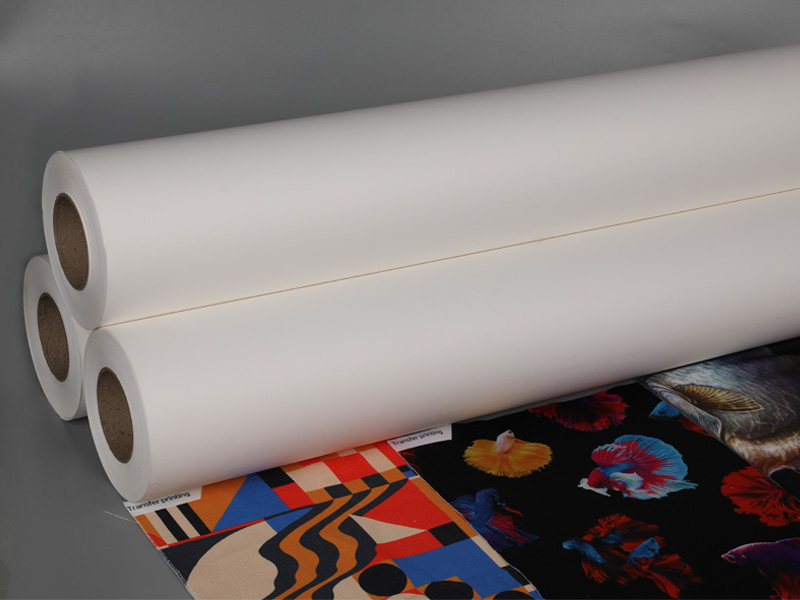 DTF 3.0-HP Paper-Based Heat Transfer FilmFor DTF setups weighing paper carriers against PET film, the recyclable DTF 3.0-HP supports hot and cold peel.View Product →
What DTF does not do: it will not match DTG softness on a white cotton tee, it adds a bench job in powder handling, and text below roughly 6 pt can lose definition once the adhesive cures.
On cotton, DTG wins on hand feel; on polyester, dark garments and stretch blends, DTF wins on colour depth, adhesion and wash durability.
A DTF transfer usually sits 60 to 120 microns above the fabric and feels slightly rubbery until the first wash relaxes it. DTG ink adds no measurable height. On wash testing to a standard such as ISO 105-C06, both reach 30 to 50 domestic cycles on their preferred substrate, and the gap only opens on mixed fabric.
DTF usually lands at a lower cost per print and higher output once daily volume passes roughly 30 to 50 pieces, while DTG stays economical on single-piece cotton orders because it consumes no film or adhesive powder.
The hidden line item is the powder station. A DTF setup needs a shaker or curing unit, and powder that ends up on the floor is money on the floor. Cost consumables per square metre of transfer, not per print, before comparing quotes.
Match the process to the order book rather than to the demo print: a cotton-first, light-colour catalogue belongs on DTG, while polyester, dark garments and mixed-substrate work belong on DTF.
One more route is worth knowing. On light-coloured 100 percent polyester, dye-sublimation transfer paper delivers the lowest cost per print and the softest hand of the three, because the ink becomes part of the fibre. It cannot print on cotton or dark polyester, so it complements rather than replaces the other two, and it often covers the sportswear work that pushes a DTG shop into buying a second machine.
Hydrotech Sublimation Transfer Paper CategoryDye-sublimation transfer papers in 29-125 gsm for light-coloured polyester, sportswear, home textiles, and promotional items.View Product →
Practical filter: count the last 200 orders by fabric and colour. If more than 30 percent of them would have been rejected or re-run on the process you own today, the second process is not a luxury.
Neither is better in absolute terms. DTF prints on more fabrics and holds colour better on dark polyester, while DTG produces a softer print on 100 percent cotton and needs no film, powder or secondary curing step.
Not reliably. DTG pigment ink needs natural fibres to bond to, so on 100 percent polyester it sits on the surface and usually cracks within a few washes. DTF and dye sublimation are the stable routes for synthetics.
A properly cured DTF transfer generally survives 30 to 50 domestic washes on cotton, polyester and blends, and it stretches with the garment because the adhesive is elastomeric. Cure temperature, powder coverage and press pressure decide whether it gets there.
The DTF printer is usually cheaper, but total entry cost is closer than the printer price suggests. DTG needs a high-end printer and a pretreat unit; DTF needs a printer, a powder shaker and a curing oven.
Buy the process that fits the order book, not the one with the better demo print.
Both processes are mature, both have narrow failure modes that a wash test exposes in an afternoon, and both reward consistent consumables far more than machine specifications. The full material catalogue covers the films, papers and inks referenced above for anyone who wants the numbers behind these comparisons.
Your email address will not be published. Required fields are marked *

 Tel: 0086-571-85192560
 E-mail: [email protected]
 Add: No.599 Baiyunyuan East Road, Tonglu Economic Development Zone, Hangzhou.